
From Mechanical Systems to Motion Control: 120 Years of Steering Evolution
May 6, 2026
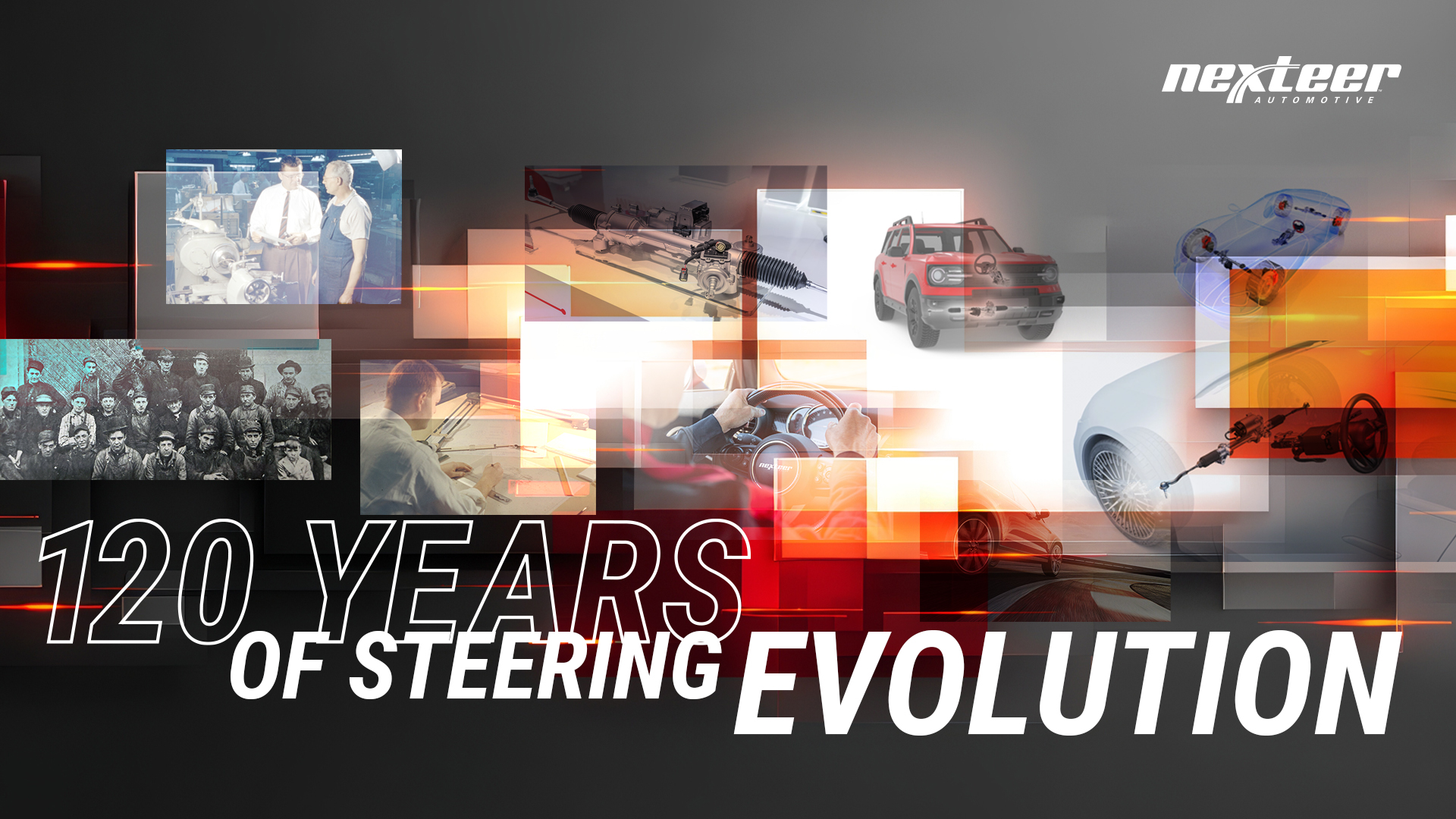
As Nexteer celebrates our 120th anniversary, we reflect on how far we’ve come as a company and an industry. Over the last century, steering has evolved from purely mechanical to hydraulic and now an electrical system—tracking the industry’s push toward safety, efficiency and software-defined vehicle architectures. We’re proud to have innovated solutions that helped propel this transformation in steering technology, working alongside OEMs to take new steering technologies from concept to production.
Each technology shift has expanded what steering can do—from primarily reducing driver effort to enabling software-based features that enhance the driving experience. The next shift, Steer-by-Wire, signals a deeper change: how vehicles translate driver intent into motion.
Here’s a look back at steering systems over our 120-year history: where we’ve been, where we are and where we’re going as we work toward a mobility future that’s safe, green and exciting.
Manual and Hydraulic Steering: The Foundation for Modern Handling
In the earliest vehicles, manual steering provided no assistance: driver input translated directly to the road wheels. This meant high driver effort—especially during parking and tight maneuvers, when tire loads are highest—and often included excessive road feedback transmitted to the driver.
The advent of hydraulic power steering (HPS) introduced steering assist, improving low-speed maneuverability, reducing unwanted road feedback. It also enabled faster steering ratios, improving vehicle responsiveness. This fundamentally improved safety and reduced driver workload, making driving and the automobile itself more appealing to the wider population. Today, Nexteer’s HPS remains a strong fit for many heavy-duty applications where high assist levels are beneficial, and the technology has continued to evolve alongside efficiency and feature expectations.
Electric Power Steering and Steer-by-Wire: Software Enters the Steering Loop
In 1995, Nexteer introduced our first electric power steering (EPS) system, accelerating the shift toward software-enabled steering. Continuing the safety and effort benefits established with HPS, EPS has since become the dominant steering architecture in passenger vehicles. This is in part because it supports software-based control strategies that can enhance safety, handling, and efficiency while increasing control over the driving experience.
By bringing software into the steering loop, EPS made steering assistance more tunable and helped enable the advanced assist features we see in vehicles today, such as park assist, lane keeping, lane departure warning, traffic jam assist and automated driving. At the same time, EPS implementations still rely on a steering wheel with mechanical linkage to road wheels, which can constrain vehicle design and limit how far the driver interface can be reimagined.
Steer-by-Wire (SbW) removes that mechanical constraint. Conceptually, it aligns with the broader industry move toward software-defined vehicles, where functionality is increasingly delivered through centralized compute, electronics and updatable control software. SbW gives Nexteer and our OEM partners freedom to rethink both the driving experience and cockpit design.
Without a mechanical connection between road wheels and the hand wheel, SbW enables new approaches to safety and comfort by allowing steering behavior to be shaped primarily through software. Steering effort and responsiveness can adapt to context such as speed and road conditions. Steering ration can change dynamically, allowing quick steering at low speeds for enhanced maneuverability, thereby enabling alternatives, such as yokes, to the traditional steering wheel. Other SbW-enabled features include enhanced stability control, automatic emergency steering, and Quiet Wheel® Steering, a Nexteer technology that reduces steering motion during automated driving for an improved occupant experience.
For more than a century, the steering wheel-and-column architecture has remained the dominant driver interface—and the dominant cockpit design constraint—even as the vehicle is transformed. SbW changes that equation by removing the requirement to have a multi-turn steering wheel and full mechanical linkage. This enables OEMs to rethink cockpit layout and create an all-new interior experience.
Looking ahead to the next 120 years, Nexteer is ready to lead the next evolution of steering innovation—where actuators, software, safety engineering and vehicle compute platforms converge.
As the next era of steering takes shape, Nexteer is advancing technologies that help OEMs translate new design freedom into real-world safety and driver confidence—as we continue to work towards a mobility future that is safe, green and exciting.